Nature Doesn’t Apologize for the Storm
We Were Meant to Feel It All
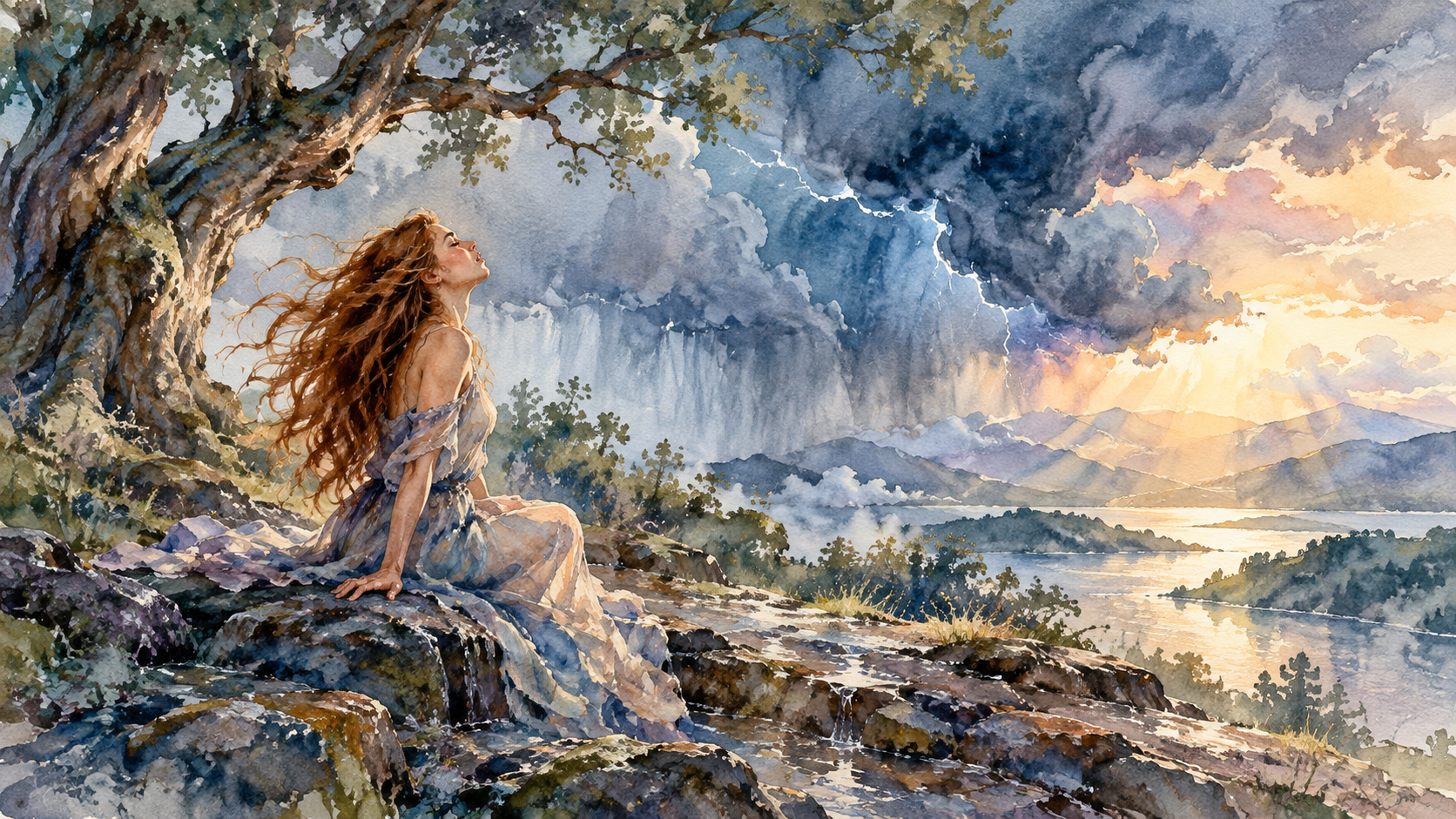
Before a storm, the air changes. The sky darkens, the wind picks up, and the trees begin to bend. Nothing in the forest tries to stop it. The branches give, the roots hold, and when the rain finally comes, the river rises and the earth drinks it in. By morning the sky has cleared, and the forest goes on living.
Nature doesn’t apologize for the storm.
We, on the other hand, apologize for ours constantly.
There is something curious about being human.
We willingly sit in darkened theaters to be frightened. We choose books we know will make us cry. We listen to music because it awakens longing, joy, grief, desire, nostalgia, or something we can’t quite name.
We ride roller coasters to feel our stomachs drop. We dance because joy wants movement. We gather at weddings because happiness grows larger when it is witnessed. We gather at funerals because grief does too.
We fall in love knowing it makes us vulnerable. We raise children knowing our hearts will someday ache because they grow. We seek wonder. We seek excitement. We seek tenderness. We even seek fear when it comes within a container we have chosen.
Why? Because emotion is part of what makes us feel alive.
"A life without sorrow may sound peaceful,
but a life without the capacity to feel deeply
would be a far greater tragedy."
And yet we live in a culture that increasingly seems uncomfortable with actually feeling. Not simply with sorrow, but with intensity itself.
We tell the grieving person it’s time to move on. We tell the frightened person not to be afraid. We tell the angry person to calm down. We tell the crying child, “You’re okay,” before we’ve asked what hurts. Someone wildly excited is told to settle down, and someone deeply moved by beauty is called overly emotional. Even joy is expected to stay within socially acceptable boundaries.
Somewhere along the way, emotional steadiness began to be confused with emotional health.
They are not the same thing.
We Were Never Meant to Feel Good All the Time
Nature does not exist in one state. The sky does not stay clear. The forest does not stay green. The river is not always gentle. There is storm and stillness, birth and death, expansion and contraction, fire and regeneration, winter and spring. Trees bend in the wind. Rain feeds the river. Forests grow back after fire.
Nothing in the natural world appears ashamed of its cycles. Yet human beings often judge themselves for having emotional seasons. We’ve come to believe that happiness, productivity, calm, and comfort mean life is going well, while grief, anger, fear, or despair mean something has gone wrong.
Sometimes something has gone wrong. There are forms of depression, anxiety, trauma, and mental illness that require real care, and for some people medication and therapy are lifesaving. This is not an argument against receiving help when help is needed.
But I do wonder whether we’ve also begun treating ordinary parts of being human as conditions from which we should be rescued. Grief hurts. Fear is uncomfortable. Anger unsettles us. Longing leaves us exposed. Even great joy can feel overwhelming.
And so we numb.
Sometimes through alcohol. Sometimes through food. Sometimes through endless scrolling, shopping, entertainment, work, busyness, or constant stimulation.
And sometimes we numb through medication.
I know that sentence will make some people uncomfortable.
Antidepressants can be lifesaving, and there are people who genuinely need them. I am not questioning that. But I do question a culture in which medication can become one of our responses to emotional suffering before we have fully asked what the emotion is asking of us.
Grief hurts because something mattered. Fear can arise because something feels threatened. The end of a relationship hurts. Losing a dream hurts. Trauma hurts. There are moments in life when pain is not evidence that we are malfunctioning. Sometimes pain is an appropriate response to what has happened.
That does not mean anyone should simply endure unbearable suffering or refuse treatment. But neither do I believe every painful emotional state is evidence that something inside us needs to be chemically quieted.
Sometimes the pain itself is part of the passage. Sometimes we need to cry until the tears have said what words cannot. Sometimes we need to rage, grieve, tremble, pray, move, speak, or sit beside the fire and acknowledge what has happened. Sometimes healing begins not when the feeling disappears, but when we finally allow ourselves to feel it.
The question is not whether medication is good or bad.
The more uncomfortable question is whether we have become so afraid of emotional pain that we sometimes interrupt a process the human being was meant to move through.
Anything can become a way of avoiding what is actually asking to be felt. The question isn’t whether any one of these things is always wrong. It is much more personal:
What am I trying not to feel?
"When comfort becomes our greatest pursuit,
we may begin sacrificing the very experiences
that give our lives meaning."
What the Numbness Taught Me
When I was thirty-five, I was told I needed a complete hysterectomy. My doctor knew I had hoped for another child, and she knew the surgery would be emotionally hard for me, so before she would operate she wanted me on Zoloft for a few months. She was being careful, and she was being kind.
But I have never felt so numb in my life. I wasn’t afraid of the surgery, but I wasn’t feeling anything else either. No joy, no sadness, no ups and downs. Just nothing.
Right after the surgery, I stopped taking it. At my six-week checkup my doctor was surprised, almost worried, when I told her. But I knew what my body, mind, and spirit needed.
I did not need to be prevented from grieving. I needed to grieve.
I needed to grieve the child I would never have, the end of that part of my life, even a certain feeling of womanhood. I let myself feel all of it, and it didn’t pull me into some deep, lasting depression. I worked through it with my spiritual practice, and sometime in that first year I realized I was ready to be grateful for everything I did have. That was the beginning of a deep healing journey of mind, body, and spirit.
It wasn’t the first time. I had suppressed the grief over my first son for years, and when I finally faced it, I found peace there too. I found it again here.
Feeling Is Not the Same as Holding
There is another side to this that matters just as much. We can suppress emotion, but we can also hold it long after it has stopped moving.
Every emotion carries information. Anger can arrive because a boundary has been crossed. Grief can arrive because something precious has changed or ended. Fear can warn us. Jealousy can reveal longing. Disappointment can show us what mattered. Joy can reveal where life is opening.
But an emotion isn’t meant to become a permanent home. We are meant to feel anger, though not necessarily to stay angry for twenty years. We are meant to grieve, though grief doesn’t have to become our only relationship with the person or the life we loved. We are meant to acknowledge what happened to us, though what happened doesn’t have to become the primary story through which we understand ourselves.
Talking about our experiences can be profoundly healing. Being believed matters. Being witnessed matters. Naming abuse, betrayal, grief, or fear can be necessary, and some pain needs to be revisited many times before it can move. I’m not arguing against that. But there can also come a point when processing becomes rehearsing, when remembering becomes reliving, and when the sentence quietly changes from:
This happened to me.
to:
This is who I am.
I don’t believe those are the same thing. I feel afraid is not the same as I am an anxious person. I am grieving is not the same as I am broken. I experienced trauma is not the same as trauma is who I am. Our experiences shape us, but they don’t have to become the whole of us. An emotion can be completely real without being permanent, and it can deserve our full attention without receiving lifelong ownership of us.
“What we refuse to acknowledge
may continue asking for our attention.
What we finally allow ourselves to feel
may no longer need to speak so loudly.”
Our Ancestors Knew Emotion Needed Movement
Human beings have always created ways to move emotion through the body and through community.
We cried together. We wailed. We sang. We drummed. We danced. We prayed. We washed ourselves in water. We sat beside fires. We buried the dead. We carried offerings. We marked endings. We marked beginnings. We told stories. We gathered in circles.
We did not expect the thinking mind to carry the entire burden of healing. There was movement. There was sound. There was land, water, fire, community, and ritual.
A piece of paper placed into a flame doesn’t magically erase what happened. A stone released into moving water doesn’t make grief disappear. A song doesn’t undo a death. But ritual gives the inner world a physical language. It allows the body to participate in what the mind already knows: something happened, it mattered, I felt it, I witnessed it, and now something is changing.
That is very different from pretending the pain never existed. Release is not denial. Release says: I no longer need to carry this in the same way.
The Body Wants to Participate
Watch a small child before they’ve learned to restrain themselves. Joy takes over their entire body. They jump, spin, run, squeal, dance. When they’re devastated, they collapse into tears. When they’re frightened, they reach for safety. When they’re angry, the whole body becomes involved.
Emotion is physical. Adults learn to contain much of this, and some containment is necessary; we can’t express every impulse wherever and however we choose. But we can become so practiced at controlling emotion that we lose the ability to experience it fully.
We hold our breath. Tighten our jaws. Swallow tears. Sit on our hands. Smile when we’re uncomfortable. Say, “I’m fine.”
The trees bend. We brace.
And the body keeps listening.
So part of healing may be letting the body back into the conversation. Cry. Dance. Shake. Laugh loudly. Walk until anger softens. Sing. Drum. Sit beside moving water. Stand barefoot on the earth. Speak what needs to be spoken. Create ritual when ordinary language is not enough.
Not because every feeling needs to become a grand spiritual ceremony, but because we are embodied beings. We do not experience life only from the neck upward.
Even Joy Needs Somewhere to Go
When we talk about emotional healing, we tend to focus on painful emotions. But joy needs expression too. So do wonder, love, and awe.
Have you ever watched someone receive extraordinary news and immediately reach for another person? Or seen a child run toward someone they love with their arms already open? Have you ever laughed so hard you could barely breathe? Danced because a song made remaining still impossible? Cried because something was so beautiful that happiness exceeded the body’s usual language?
These experiences matter too. A full emotional life isn’t simply about becoming better at tolerating pain. It’s about becoming available to life, all of it: the ecstatic, the frightening, the ridiculous, the tender, the heartbreaking, the beautiful, the mysterious.
We cannot selectively numb ourselves very well. When we spend our lives avoiding vulnerability, grief, fear, and uncertainty, we may also narrow our capacity for awe, intimacy, joy, and wonder. A protected heart may hurt less. But it may also experience less.
"We cannot choose to experience only
the beautiful parts of being human
and still know the full beauty of being alive."
Emotion Is a Visitor, Not an Identity
Perhaps the wisdom is neither to suppress emotion nor to worship it, but to let it move. To listen without immediately trying to silence it. To experience without immediately becoming it. To ask: What are you showing me? What needs expression? What needs witnessing? What needs grieving, celebrating, or changing? And eventually: What am I ready to release?
Maybe healing isn’t about feeling less. We imagine the healed person as perpetually calm, unbothered, centered, and positive, but that may not be what being whole looks like. The healed person may still cry deeply. Laugh loudly. Feel anger when something matters. Experience fear. Fall passionately in love. Miss people. Grieve. Celebrate. Dance.
And then allow each of those experiences to move. Emotional health may not be the absence of intensity at all, but the ability to feel without needing to suppress it, escape it, cling to it, or become it.
The Storm and the Oak
Last year, the warnings began arriving: extremely high winds heading toward our area. My phone dinged so many times I lost count. At first I thought it wasn’t a big deal. Then I walked outside to help my husband move something he felt we should move, just in case, and I felt it too. There was reason to be afraid.
I went and made an offering to the land spirits and asked them to protect our home.
The storm lasted less than ten minutes. We had gone down to the basement just in case, and when we heard calm, we came back up and looked out the back window. A sixty-foot oak had fallen.
The devastation across the area was visible. Like many around us, we lost electricity for five days, the longest I have ever been without it. But the old oak had fallen in the one place that spared us. She didn’t touch the house or the pool. She broke some fencing and a little of the stonework around the pond.
I sat with her for the next three days and watched her begin to fade. I grieved her, and I was grateful she fell where she did. Both were true at once.
She was beautiful, and in falling she opened up space. Right where she had stood, we had a stone patio set in, a sitting area beside the pond. This summer we spent so many evenings there, in the very place she had held for so long.
That is what nature shows us, over and over. The storm came, and it was over in minutes. The oak fell. The sky cleared, the land received her, and grief and gratitude sat side by side until there was room for something new.
We aren’t so different. We came here to experience the extraordinary range of what it means to be human: to love deeply enough that grief becomes possible, to care enough that anger sometimes rises, to risk enough that fear sometimes appears, and to stay open enough that wonder can still stop us in our tracks.
To laugh. To ache. To tremble. To rejoice. To mourn. To be moved.
And then, when the moment has given us what it came to give, to let it move through us.
Maybe the goal was never to feel less. Maybe it was to become capable of feeling everything without losing ourselves inside any one thing.
Because emotion is not evidence that we are failing at life.
Emotion is evidence that we are participating in it.
In the beauty of feeling it all,